Type
Design
Role
Individual
Date
2026
#
Design
#
Product
#
Installation
#
Computing
#
Development
Olfaction
Translating invisible ecological signals into actionable intelligence.

Olfaction
Olfaction is an ecological sensing system that captures volatile organic compounds (VOCs) emitted by plants and translates them into interpretable digital information. Rather than responding to visible symptoms after they occur, the project explores how biological signals can become the earliest interface between ecosystems and intelligent systems.
Living systems continuously emit invisible biological signals that reveal physiological and environmental changes long before they become visible. By making these signals perceptible, Olfaction enables earlier perception, interpretation, and decision-making across agriculture and broader ecological systems.
Rather than functioning as a standalone sensor, Olfaction represents the sensing layer of a broader ecological intelligence framework—one in which environmental information is continuously perceived, interpreted, and transformed into meaningful actions.


Position
Current environmental monitoring primarily depends on visual observation or periodic manual inspection. These methods often detect problems only after physical symptoms become visible, limiting opportunities for early intervention.
Yet ecosystems continuously communicate through chemical signals. Plants emit complex VOC patterns that reveal stress, disease, environmental change, and interactions with surrounding organisms long before these conditions become perceptible to humans.

Plant defense responses do not occur uniformly, but are highly correlated with pest density, climatic conditions, and environmental stress.

Approach
Olfaction as part of a continuous ecological feedback loop connecting plants, humans, technology, and the environment. Biological signals are perceived, translated into computational models, interpreted by intelligent systems, and ultimately returned to the environment through informed actions. Each intervention reshapes the ecosystem, generating new signals and establishing a continuous cycle of perception, interpretation, and adaptation.
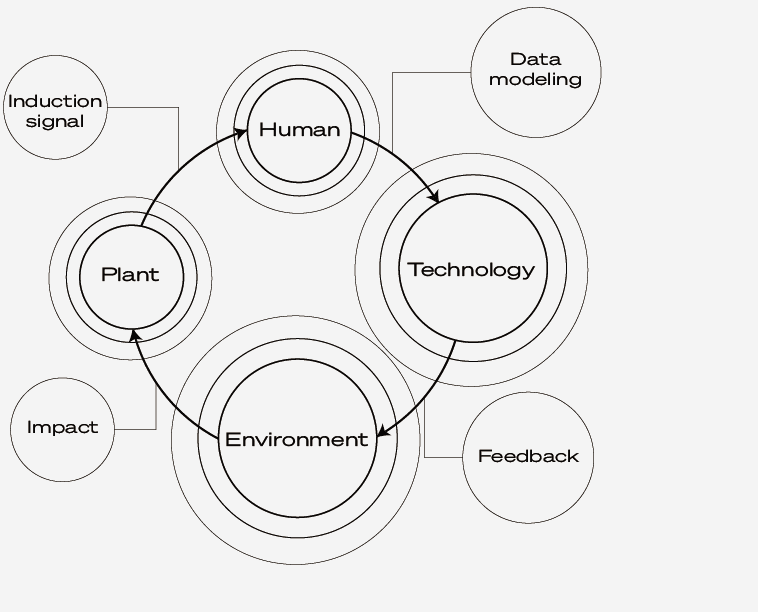
The system transforms biological emissions into actionable intelligence through four interconnected stages:
Capture — sensing volatile organic compounds released by plants.
Interpret — extracting meaningful patterns from multivariate sensor data.
Model — building machine learning representations of ecological states.
Act — supporting environmental monitoring, early warning, and autonomous decision-making.

Experiment
Chemical Verifying of Biological Signals
This experiment explored chemical colour reactions as a method for validating the existence of plant volatile organic compounds (BVOCs) at the molecular level. It investigated whether invisible biological signals could be experimentally observed and verified through chemical transformation.
By establishing evidence for the presence and behaviour of BVOCs, the study provided a scientific foundation for evaluating the feasibility of plant-based sensing and informed the design principles of subsequent electronic sensing prototypes and interaction systems.
Click here to go to the experiment page


Process
Hardware Stack
Modular digital olfactory prototypes capture environmental and chemical signals via distributed gas sensors, subsequently uploading data to train AI models for monitoring and predicting ecological changes through plant communication signals.
Overview
Arduino Nano 33 BLE Sense
(control & data logging)
BME688 × 6
(VOC-sensitive gas sensor array)
PCA9548A I²C multiplexer
(expandable multi-sensor addressing)
Battery
boost module

Sampling Logic
From signal acquisition to local deployment, each stage is designed to improve data consistency, reduce sensor drift, and establish a stable foundation for machine learning models operating in real-world environments.

Prototype
The prototype is built as a modular sensor unit, integrating the NANO 33 BLE controller and the BME688 distributed gas sensor.
The airbag circulation system manufactured from TPU material reduces environmental interference and enhances the accuracy of data acquisition.

Data Collection
Each collection records not note a single “value”, but an entire segment of the sensor's variation curve, including the baseline, amplitude of change, and plateau phase.In addition, for data reliability each situation requires three rounds of collection, spaced at three-minute and twelve-minute intervals respectively.

The large model transforms sensor time-series into interpretable patterns and decision cues for early ecological intervention.

Output

Olfaction establishes a new sensing paradigm in which biological signals become computational resources. Beyond agriculture, the framework can support environmental monitoring, ecological robotics, biodiversity research, and future autonomous systems that interact directly with living environments.
Rather than replacing human observation, it extends perception into phenomena that were previously invisible.
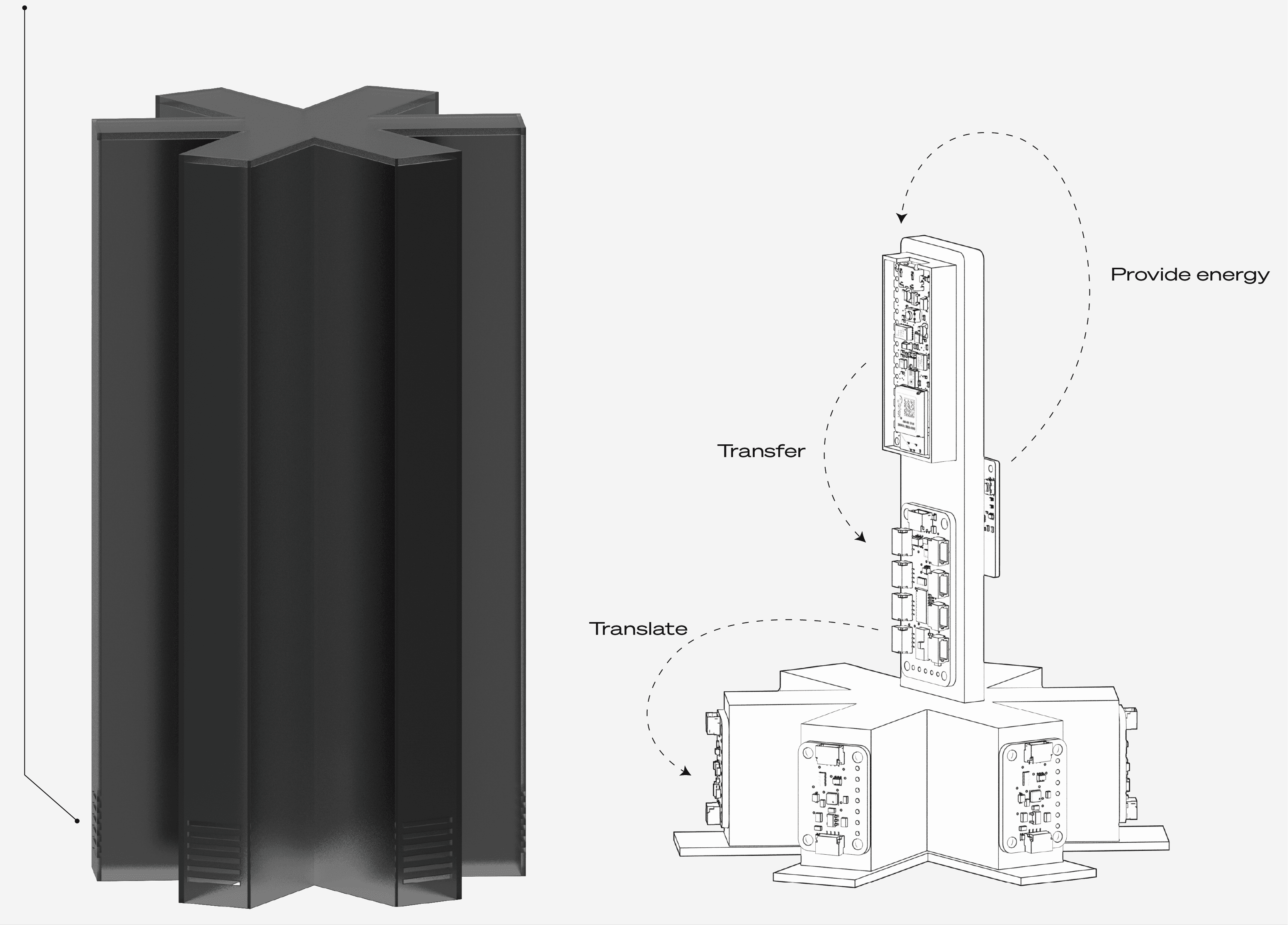
Olfaction modular internal architecture with a central I²C hub and distributed sensor nodes for multi-point VOC sampling.

To evaluate the robustness of the sensing system, Olfaction was deployed across diverse outdoor environments where airflow, temperature, humidity, and surrounding vegetation continuously changed.
Rather than testing under controlled laboratory conditions, these field experiments examined how biological signals could be captured, distinguished from environmental noise, and translated into reliable data for ecological monitoring.


This is a modular housing designed specifically for distributed olfactory sensing. It centralizes control and I²C wiring, protects electronic components, and features six distributed air inlets.
This internal structure is designed for modular sensing assembly. It centralizes the controller and I²C multiplexer, routes power and data through a clean wiring layout, and distributes sensor nodes around the frame for multi-point sampling.
Impact
Toward Ecological Intelligence
Although developed around plant volatile organic compounds, the framework is designed to expand beyond a single sensing modality.
Potential applications include precision agriculture, ecosystem restoration, biodiversity monitoring, forestry, environmental risk assessment, and autonomous robotic systems capable of perceiving biological conditions in real time.
As ecological datasets continue to grow, Olfaction aims to become part of a broader infrastructure connecting sensing, machine learning, and environmental decision-making.
